The Most Overlooked and Overhyped Marketing Trends of 2020
The top three most overlooked and most overhyped marketing trends in 2020, according to almost 400 Marketing Brew readers
Francis Scialabba
The top three most overlooked and most overhyped marketing trends in 2020, according to almost 400 Marketing Brew readers
Francis Scialabba
Every year, like clockwork, all the major marketing publications write the exact same piece of content. It’s called the “20XX Marketing Industry Predictions” list, and—mark my words—everyone on Marketing Twitter™ has shared one by now.
Spoiler alert: This isn’t one of those lists.
Rather than creating a 2021 predictions list based on our unparalleled wisdom (or educated guesstimates) we threw it in reverse and kicked it back to our audience. That’s right: If you answered our recent survey asking marketers to choose their top three most overlooked and most overhyped trends in 2020, this list came from you.
Think of this piece as Marketing Brew’s Audience Choice Awards, but for marketing trends rather than Nickelodeon stars.
Why me? We know we have a smart group of marketing professionals on our hands here, so we figured, who better to weigh in on what industry trends were most overhyped and overlooked in 2020 than nearly 400 of our most engaged readers?
Francis Scialabba
Out of a list of 15 top marketing trends, you all identified the following five as the most overlooked in 2020.
No. 1, No. 2, and No. 5 were by far the most interesting to us—read on to find out why.
Y’all had some feelings about this one. “Micro-influencers gaining prominence” was the only trend to be among the top 5 most overlooked AND most overhyped.
Quick refresher: A micro influencer = a brand partner with 1,000 to 10,000 social media followers. Other common characteristics include specializing in a particular nicheand high engagement rates, per Hubspot.
It’s not a generational divide: Both execs and your average marketing Joe had strong, mixed feelings about how micro-influencers were treated as a trend, so it’s not simply a difference of position thing—these influencers stir up controversy from the intern to the CMO.
But it’s probably a scale issue: Some types of brands, like local brands looking to geotarget a specific group, need micro-influencers to thrive. Others—like global DTC fashion brand Revolve, which seems to primarily target influencers with around 1 million followers—probably find celebrity influencers more useful for their general brand awareness plays.
Bottom line: More brands found success with micro-influencers this year—but that doesn’t mean they resonate with every brand’s goals.
If you’re curious why so many readers felt micro-influencers were overlooked this year, here are some fast facts from the ANA about the pros of micro-influencing:
Based on the results of our poll…there’s a small chance some respondents don’t truly understand how important the third-party cookie’s exit is to our industry. The gap between execs and overall respondents was bigger than The Gap’s 2002 flagship store.
Zoom out: In case you’ve been living under a baking sheet, here’s how Hubspot explained the death of the third-party cookie and why it matters to advertisers:
Digging deeper: The third-party cookie’s departure is complicated, and exec respondents viewed it as more impactful than the average marketer respondent did. Perhaps that’s because while CMOs have to think about every aspect of their marketing strategy—from programmatic to events—more specialized employees might never have to touch a cookie, in practice.
Either that, or the opposite is true and the execs calling the shots thought we were talking about actual cookies.
If you want to learn more abou why third-party cookies are so important, here are a few guides to get you started:
Okay, so maybe in-house marketing teams have been on the rise for years now—so much so that the move away from agencies was even referenced in Emily in Paris. But Covid-19 turned the trend-o-meter up to 11.
Brands taking marketing in-house barely made the top five overlooked marketing trends in this poll. There was a difference of only 1% between slots number five and six here.
Why it matters: That said, I agree that the in-housing trend is a bigger deal than the industry made it out to be in 2020. Here’s why:
For context, here are the most important in-housing announcements from the past year:
We gave Marketing Brew readers who participated in our Overlooked/Overhyped survey the chance to write in anything we missed.
Two notable overlooked write-ins below:
Francis Scialabba
Out of a list of 15 marketing trends, savvy readers called these the five most overhyped last year.
The top three in particular made the Brew Crew nod over our coffee cups.
We can all agree on one thing—none of us could shut up about TikTok this year. Execs and marketing pros across the board ranked it as the most overhyped topic of the year, and by a very wide margin. But in my opinion, some* of the hype was warranted.
*But definitely not all the hype—I could have made it through 2020 without 100 think pieces on how TikTok houses will redefine the marketing industry. While a new social media marketing platform is (really!) exciting for marketers, it's still too early to know if it can rival the efficacy of established tech giants like Facebook and Twitter.
In other words, we just need more patience while TikTok develops its marketing arm before raving about it this much. The platform is still young, and has plenty of time to fall flat—don’t make me bring up Vine.
If you’re looking for a solid think piece about why people were so excited about TikTok this year, here are my suggestions. Xoxo, a social media marketing-obsessed gal who had to read all these for her job (and even write a few).
In June, no one in the marketing world could stop talking about dozens of big-name advertisers such as Walgreens and Coca-Cola boycotting Facebook due to the social network’s inaction on hate speech. But despite almost every top individual advertiser on FB pausing advertising on FB or Insta in some way, shape, or form, Facebook raked in record earnings.
That’s because of DTCs: Glossier and Casper’s FB ad campaigns kept right on truckin’ during the boycott—but that’s not because they agreed with Facebook’s allowing hate speech on the platform.
Big picture: Small and medium-sized businesses (SMBs) account for nearly 75% of Facebook's yearly ad rev, hence Facebook’s record earnings despite major spenders’ boycotting the platform.
Was the hype worth it? Yes and no.
No: The boycotts didn't end up making a dent in Facebook’s ad rev, despite marketers’ best efforts. And Facebook didn’t meet a lot of boycotter demands as a result.
But also, yes: It’s not every day a bunch of corporate giants decide to publicly denounce another corporate giant, and Facebook did make some changes as a result of the boycott.
ICYMI: Our 2020 Facebook boycott coverage is below.
Spoiler alert: Instagram didn’t do it, even after social media marketers spent much of Q4 2019 and Q1 2020 worrying about a world without likes. To me, that’s the definition of overhyped. Perhaps that’s because we haven’t spoken about this once since the pandemic began, which feels like at least 40 years ago.
Best of the “What to do when Instagram was removing likes” articles, just in case it ever does happen:
Marketing Brew readers always come through—hence why many of you responded with your own most “overlooked” or “overhyped” trends that we left out.
Two notable overhyped write-ins below:
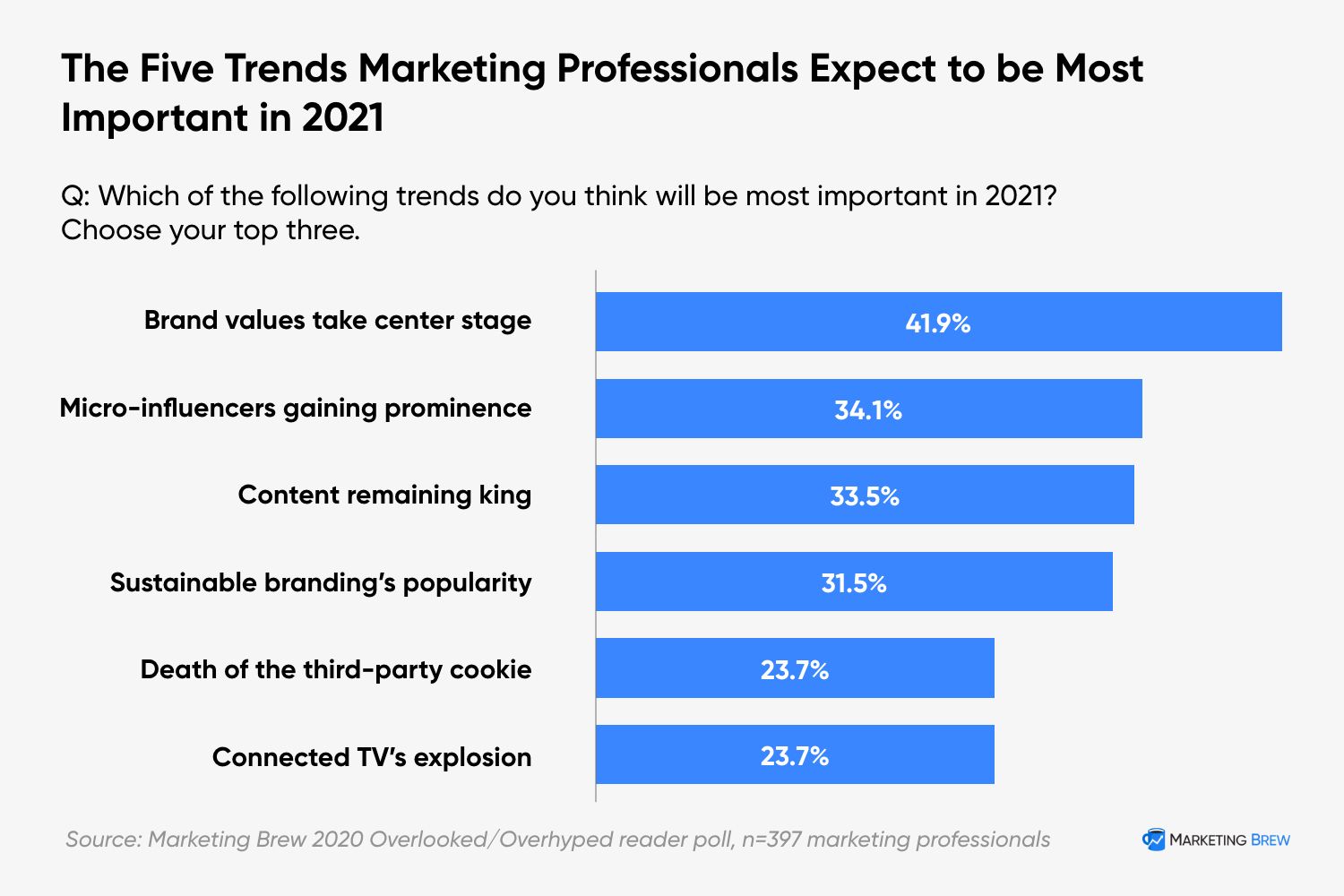
In addition to thinking about what marketers overhyped and underhyped in 2020, we also asked respondents to think about the most important trends in 2021. Check back next year to see if you were right, but as of 2020, Marketing Brew’s audience thought brand values will be extra important in 2021.
Francis Scialabba